
Smartphones have become one of the most important pieces of technology in modern life. What started as a simple communication device has evolved into a powerful computer that fits inside a pocket. Today, people use smartphones for communication, entertainment, education, shopping, banking, photography, navigation, work, social media, and much more.
But smartphone technology is far from finished.
The smartphones of the future will not simply be faster versions of today’s devices. They are likely to become more intelligent, more connected, more energy-efficient, and more integrated with other technologies. Artificial intelligence, foldable displays, satellite communication, advanced cameras, new battery technologies, augmented reality, and powerful mobile processors are already changing the smartphone industry.
In the coming years, smartphones may become less like traditional phones and more like personal digital assistants that understand users, predict their needs, and interact naturally with the world around them.
In this article, we will explore the major technologies that could transform mobile devices and explain what the future of smartphones may look like.
📱 How Smartphones Have Changed
Before looking at the future, it is useful to understand how quickly smartphones have evolved.
Early mobile phones were primarily designed for calling and texting. Later, smartphones introduced features such as:
- 🌐 Internet browsing
- 📸 Digital cameras
- 🎵 Music players
- 🗺️ GPS navigation
- 📱 Touchscreens
- 📲 Mobile applications
- 💳 Mobile payments
- 🤖 Artificial intelligence
Modern smartphones can perform many tasks that once required separate devices.
A single smartphone can replace:
- A camera
- A GPS device
- A calculator
- A music player
- A video player
- A notebook
- A flashlight
- A gaming console
- A payment card
- A computer for many everyday tasks
The next generation of smartphones will continue this trend.
🤖 Artificial Intelligence Will Become the Heart of Smartphones
One of the biggest changes coming to smartphones is the deeper integration of artificial intelligence.
AI is already present in many mobile features, including camera processing, voice assistants, translation, photo editing, spam detection, and recommendations.
However, future smartphones will likely use AI much more extensively.
Instead of simply responding to commands, smartphones may understand context.
For example, imagine telling your phone:
“Help me prepare for tomorrow’s meeting.”
The phone could potentially examine your calendar, identify the meeting, summarize relevant documents, prepare notes, suggest questions, and remind you about important information.
AI could also learn how users interact with their devices.
A future smartphone may understand:
- Your usual schedule
- Your communication habits
- Your preferred applications
- Your writing style
- Your frequently visited locations
- Your work patterns
- Your entertainment preferences
This could make smartphones much more personalized.
🧠 On-Device AI
Another major development is on-device artificial intelligence.
Currently, many AI services rely heavily on cloud servers. Your phone sends information to a remote server, the server processes it, and the result is sent back.
Future smartphones will increasingly perform AI processing directly on the device.
This offers several advantages.
🔒 Better Privacy
Sensitive information can potentially remain on the smartphone rather than being sent to a remote server.
⚡ Faster Responses
On-device processing can reduce the delay between an action and an AI response.
📡 Less Dependence on the Internet
Some AI features could work even when the phone has limited or no internet connectivity.
🔋 Better Efficiency
Specialized AI processors can perform certain tasks more efficiently than general-purpose processors.
This means future smartphones may have dedicated hardware specifically designed for AI workloads.
🧩 More Powerful Smartphone Processors
The processor is essentially the brain of a smartphone.
Modern mobile processors are already extremely powerful, but future chips will become even more capable.
Smartphone chipsets are expected to combine:
- CPU processing
- GPU graphics
- AI acceleration
- Image processing
- Security features
- Connectivity processing
This combination allows smartphones to perform increasingly complex tasks.
Future processors could make mobile devices capable of handling tasks that currently require laptops or desktop computers.
For example, smartphones may become better at:
- Professional video editing
- 3D rendering
- AI content generation
- Advanced gaming
- Real-time language translation
- Computer vision
- Augmented reality
The line between smartphones and computers could become increasingly difficult to define.
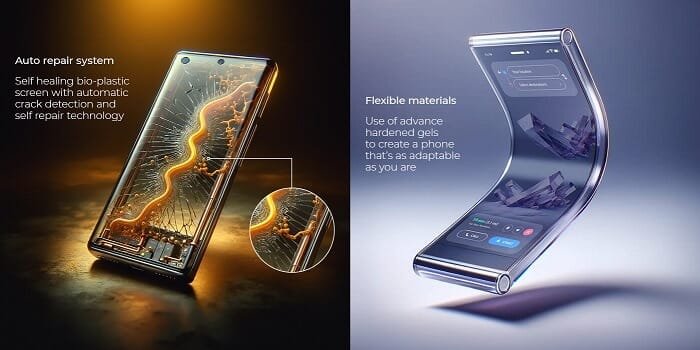
📺 Foldable and Flexible Displays
Foldable smartphones have already introduced a new direction for mobile design.
Instead of using a traditional flat screen, foldable phones can expand into larger displays while remaining relatively compact when closed.
Future foldable devices could become even more advanced.
We may see:
- 📖 Book-style folding phones
- 📜 Rollable displays
- 🔄 Multi-fold devices
- 🖥️ Phones that transform into tablet-sized screens
- 🧩 Flexible displays with unusual shapes
Imagine carrying a smartphone that fits inside your pocket but can expand into a large workspace when needed.
This could make mobile productivity much easier.
📱 Rollable Smartphones
Foldable displays are only one possibility.
Rollable displays could allow a smartphone screen to expand by sliding or rolling outward.
For example, a device could have a compact screen for normal use. When watching a video or working on a document, the display could expand automatically.
This technology could provide a larger display without requiring a permanently large device.
However, durability will remain an important challenge.
Flexible screens and moving components must survive thousands of opening, closing, rolling, and bending cycles.
🔋 The Future of Smartphone Batteries
Battery life remains one of the biggest limitations of smartphones.
Even as processors become more efficient, users continue demanding more from their devices.
Future battery technologies could change this.
Researchers and manufacturers are exploring different approaches, including:
- Higher-density batteries
- Silicon-based battery materials
- Solid-state battery technologies
- Faster charging
- Improved thermal management
- More efficient processors
- Adaptive power management
The goal is not simply to make batteries larger.
The ideal smartphone battery would provide more energy while taking up less space.
⚡ Faster Charging
Charging technology is also expected to improve.
Future smartphones may charge significantly faster than today’s devices.
A short charging session could potentially provide enough power for many hours of use.
However, faster charging introduces challenges such as heat generation and battery degradation.
Future charging systems will therefore need to become more intelligent.
Smart charging could automatically adjust charging speed depending on:
- Battery temperature
- Battery health
- User schedule
- Current battery level
- Expected usage
For example, a smartphone could learn that you usually wake up at 7 AM and finish charging shortly before you wake up rather than keeping the battery at maximum charge all night.
📡 Satellite Connectivity
One of the most interesting developments in mobile communication is satellite connectivity.
Traditional mobile networks require nearby cellular towers. Satellite communication can provide connectivity in areas where traditional networks are unavailable.
This could be especially useful for:
- Remote locations
- Mountains
- Deserts
- Oceans
- Emergency situations
- Natural disasters
- Areas with damaged cellular infrastructure
Future smartphones may offer more advanced satellite communication capabilities.
Instead of being limited to emergency messages, satellite technology could eventually support broader communication services.
🌐 5G, 6G, and Beyond
Mobile networks are also evolving.
5G has already improved mobile connectivity through higher speeds, lower latency, and better support for connected devices.
The next generation of mobile networks, often referred to as 6G, is expected to explore even more advanced capabilities.
Potential improvements could include:
- Extremely low latency
- Higher data speeds
- More reliable connections
- Better support for AI systems
- Massive numbers of connected devices
- Advanced location technologies
Future smartphones may use these networks to communicate with cloud systems, vehicles, smart homes, wearable devices, and other connected technologies almost instantly.
📸 Revolutionary Smartphone Cameras
Smartphone cameras have improved dramatically.
Modern smartphones can produce high-quality photos using computational photography, artificial intelligence, multiple cameras, and advanced image sensors.
Future cameras may become even more intelligent.
Instead of simply capturing an image, AI could understand the entire scene.
For example, the smartphone might automatically recognize:
- People
- Objects
- Buildings
- Text
- Lighting conditions
- Movement
- Background elements
It could then optimize the image automatically.
🌙 Better Low-Light Photography
Night photography is another area where smartphones are improving.
Future devices may use advanced sensors and AI algorithms to capture clearer images in extremely low-light conditions.
Computational photography could combine multiple frames and intelligently reconstruct details that are difficult to see with the human eye.
This could make smartphone cameras increasingly competitive with dedicated cameras for everyday photography.
🎥 Professional Mobile Video
Smartphones are already capable of recording high-quality video.
Future devices could provide even more advanced features such as:
- Better stabilization
- Higher-resolution recording
- AI-powered editing
- Automatic subject tracking
- Real-time background processing
- Improved audio capture
- Cinematic effects
AI could automatically edit a long recording into a short professional-looking video.
For content creators, this could significantly reduce the need for additional equipment and software.
🔐 Improved Smartphone Security
As smartphones become more important, security will become even more critical.
Future devices may use multiple layers of biometric authentication.
These could include:
- Face recognition
- Fingerprint recognition
- Voice recognition
- Behavioral patterns
- Eye-based authentication
- Continuous device authentication
Instead of authenticating only when unlocking the phone, a future smartphone could continuously analyze whether the person using the device appears to be the authorized user.
Security hardware could also protect sensitive information such as passwords, financial information, and encryption keys.
👁️ Privacy-Preserving Technology
Smartphones are increasingly collecting personal information.
Future devices will therefore need stronger privacy controls.
Users may have more control over:
- Camera access
- Microphone access
- Location information
- Contacts
- Personal files
- Health information
- Application permissions
AI could also help identify suspicious application behavior.
For example, a smartphone might warn:
“This application is attempting to access your microphone unusually often.”
Such intelligent security systems could help users understand what applications are doing behind the scenes.
🥽 Smartphones and Augmented Reality
Augmented reality, or AR, could significantly change the role of smartphones.
AR overlays digital information onto the physical world.
For example, you could point your camera at a building and receive information about it.
You could point your phone at a foreign-language sign and see a translation.
You could point the camera at furniture and see how a different product might look inside your room.
Future smartphones may combine AI, cameras, sensors, and AR to create much more interactive experiences.
🕶️ The Smartphone May Eventually Work With Smart Glasses
One possible future is that smartphones will become less visible.
Instead of constantly looking down at a screen, people may use smart glasses connected to their phones.
The smartphone could provide:
- Processing
- Internet connectivity
- Storage
- AI services
- Security
- Battery power management
Smart glasses could display information directly in the user’s field of view.
For example:
- Navigation directions could appear in front of you.
- Messages could be displayed without opening your phone.
- Real-time translations could appear over conversations.
- Notifications could appear discreetly.
This could create a new form of computing beyond traditional smartphone screens.
🎮 Gaming on Future Smartphones
Mobile gaming has become a major part of the smartphone industry.
Future phones could offer even more powerful gaming capabilities.
Advanced processors and GPUs could deliver:
- Console-quality graphics
- Higher frame rates
- Ray-tracing capabilities
- Better cooling
- Faster network connections
- AI-powered game features
Cloud gaming could also allow users to play demanding games without storing large game files locally.
However, local processing will remain important for reducing latency.
☁️ Smartphones and Cloud Computing
Future smartphones will likely work as part of a larger computing ecosystem.
Instead of keeping everything on one device, users may move smoothly between:
- Smartphones
- Tablets
- Laptops
- Smart glasses
- Smart TVs
- Cars
- Wearable devices
Your work could follow you from one device to another.
For example, you might start editing a document on your phone, continue on a laptop, and review it using smart glasses.
Cloud computing will help synchronize these experiences.
🚗 Smartphones and Smart Cars
Smartphones are also becoming increasingly connected to vehicles.
Future cars could recognize your smartphone automatically.
Your phone could act as:
- A digital car key
- A navigation system
- An entertainment controller
- A personal assistant
- A payment device
- A vehicle settings profile
When you enter a car, the vehicle could automatically load your preferred settings.
This could include:
- Seat position
- Climate preferences
- Music
- Navigation destinations
- Driving profiles
Smartphones could become central controllers for connected vehicles.
🏠 Smartphones and Smart Homes
The same concept applies to smart homes.
Your smartphone could control:
- Lights
- Security cameras
- Door locks
- Thermostats
- Appliances
- Speakers
- Smart TVs
AI could make this interaction more automatic.
Instead of manually controlling every device, you might simply tell your phone:
“I’m leaving home.”
The system could then turn off unnecessary lights, adjust the thermostat, activate security features, and perform other configured actions.
🌍 Smartphones and Environmental Technology
Future smartphone development will also focus on sustainability.
Electronic waste is a growing global problem.
Manufacturers may increasingly use:
- Recycled materials
- More durable components
- Repairable designs
- Energy-efficient processors
- Longer software support
- Improved battery recycling
Longer-lasting smartphones could reduce the number of devices discarded every year.
Software updates will also become increasingly important because keeping a phone secure and useful for longer can reduce unnecessary upgrades.
🔧 More Repairable Smartphones
For years, many smartphones have become increasingly difficult to repair.
Future regulations and consumer demand could encourage manufacturers to make devices more repairable.
This could mean easier replacement of:
- Batteries
- Screens
- Charging ports
- Cameras
- Other components
A more modular design could allow users to replace individual components rather than replacing the entire phone.
That would benefit both consumers and the environment.
🧑💻 Smartphones Could Replace More Computers
For many people, smartphones already perform most everyday computing tasks.
Future smartphones could become even more powerful.
With a compatible monitor, keyboard, and mouse, a smartphone could potentially function as a desktop computer.
The phone would provide the processor, storage, internet connection, applications, and AI capabilities.
This could be particularly useful in regions where smartphones are more accessible than traditional computers.
🧠 Smartphones That Understand Context
One of the biggest changes may not be physical at all.
It could be the intelligence of the software.
Future smartphones may understand context much better.
For example, if you are traveling to another country, your phone could automatically provide:
- Translation assistance
- Currency information
- Navigation
- Travel reminders
- Local information
- Emergency assistance
Instead of opening multiple applications, you could communicate with one intelligent system.
🎙️ Natural Voice Interaction
Voice assistants have existed for years, but future systems may become much more natural.
Users may speak to smartphones using normal conversation rather than specific commands.
You could say:
“Find the photos from my trip last summer and create a short video.”
The phone could understand the request, locate relevant images, create the video, and present the result.
This type of interaction could make smartphones easier to use.
🧬 Health and Wellness Features
Smartphones may also become more connected to personal health and fitness technologies.
Sensors and wearable devices could provide information related to:
- Activity
- Sleep
- Heart rate
- Exercise
- Stress indicators
- General wellness
The smartphone could analyze this information and provide useful insights.
However, privacy and accuracy will be extremely important when dealing with health-related information.
💬 Real-Time Translation
Language barriers could become much smaller.
Future smartphones may offer real-time translation during:
- Phone calls
- Video calls
- Face-to-face conversations
- Text messaging
Imagine speaking your language while another person hears your words in their language almost immediately.
AI-powered translation could make international communication easier than ever.
🧩 Smartphones Will Become More Personalized
The smartphone of the future may feel less like a general-purpose product and more like a personal digital environment.
AI could customize:
- Home screens
- Notifications
- Application suggestions
- Battery management
- Communication
- Search results
- Security settings
The phone could continuously adapt to how its owner uses it.
⚠️ Challenges of Future Smartphones
The future will not be completely positive.
New smartphone technologies will create new challenges.
🔋 Battery Limitations
More powerful AI and displays require energy.
Manufacturers must improve efficiency alongside performance.
🔐 Privacy Concerns
More intelligent phones may require access to more personal information.
Users need strong privacy protections and transparent controls.
💰 High Costs
Advanced technologies may initially make smartphones expensive.
♻️ Electronic Waste
Frequent upgrades could increase environmental problems.
🛠️ Repairability
Advanced designs may become difficult to repair if manufacturers prioritize thinness over accessibility.
🤖 AI Dependence
Users could become overly dependent on automated systems.
Human judgment will remain important.
🔮 What Will Smartphones Look Like in the Future?
It is difficult to predict exactly what smartphones will look like ten years from now.
They may still resemble today’s devices, or they could become completely different.
Possible future designs include:
- Foldable phones
- Rollable phones
- Transparent displays
- Modular smartphones
- Nearly bezel-free devices
- Phones connected to smart glasses
- AI-first devices
- Screenless or reduced-screen interfaces
The biggest change may be that smartphones become less noticeable.
Instead of constantly interacting with a rectangular screen, people may communicate with digital systems through voice, gestures, glasses, wearables, and other interfaces.
📊 The Smartphone of the Future
A future smartphone could combine all of these technologies:
- 🤖 Advanced artificial intelligence
- ⚡ Extremely powerful processors
- 🔋 Better battery technology
- 📱 Flexible displays
- 📡 Satellite connectivity
- 🌐 Next-generation mobile networks
- 📸 Professional-level cameras
- 🔐 Advanced security
- 🥽 Augmented reality
- ☁️ Cloud computing
- 🚗 Smart vehicle integration
- 🏠 Smart home control
- 🎙️ Natural voice interaction
- 🌍 Real-time translation
- ♻️ Sustainable materials
The result could be a device that is much more capable than today’s smartphone.
❓ Frequently Asked Questions
1. What is the future of smartphones?
The future of smartphones will likely involve stronger AI, better cameras, faster processors, improved batteries, flexible displays, satellite connectivity, advanced security, and deeper integration with other smart devices.
2. Will smartphones disappear?
Smartphones may not disappear completely, but their role could change. Smart glasses, wearables, voice interfaces, and other technologies may reduce the amount of time people spend interacting directly with phone screens.
3. Will AI become more important in smartphones?
Yes. AI is expected to become one of the most important technologies in future smartphones, supporting photography, communication, productivity, security, translation, search, and personal assistance.
4. Will future smartphones have better batteries?
Battery technology is expected to improve through better materials, higher energy density, faster charging, and more efficient processors.
5. Will foldable phones become mainstream?
Foldable and flexible designs could become more common if manufacturers solve major challenges involving durability, cost, thickness, and battery capacity.
6. Can smartphones replace computers?
For many everyday tasks, smartphones already can. More powerful processors, desktop-style software, cloud computing, and external displays could allow future smartphones to replace computers for an even larger number of users.
7. Will smartphones work without mobile networks?
Satellite communication could allow certain smartphone functions to work in areas without traditional cellular coverage.
8. How will smartphone cameras improve?
AI, larger or more advanced sensors, computational photography, improved stabilization, and better image processing could make smartphone cameras even more powerful.
9. Will smartphones become more secure?
Future smartphones are likely to use stronger hardware security, biometrics, AI-powered threat detection, encryption, and better privacy controls.
10. What will be the biggest smartphone innovation?
There may not be one single innovation. The biggest transformation will likely come from combining AI, advanced processors, connectivity, flexible hardware, and intelligent software into one ecosystem.
🚀 Conclusion
The future of smartphones is much bigger than simply making phones faster or adding more cameras.
Smartphones are becoming intelligent computing platforms that connect people with the internet, artificial intelligence, vehicles, homes, wearable devices, satellites, and digital services.
Artificial intelligence may become the most important part of this transformation. Future phones could understand conversations, recognize situations, automate tasks, translate languages, improve photos, protect users, and provide personalized assistance.
At the same time, hardware will continue evolving through foldable displays, powerful processors, advanced cameras, improved batteries, satellite connectivity, and new communication technologies.
The smartphone of the future may not look dramatically different from today’s phone at first glance. But underneath the screen, it could be far more intelligent and capable.
Ultimately, the future of smartphones will not only be about technology. It will be about how naturally technology fits into our lives.
The most successful future devices will be those that make everyday tasks easier, protect user privacy, save time, connect people more effectively, and provide powerful technology without making life unnecessarily complicated.