Artificial Intelligence, commonly known as AI, has moved from being a futuristic concept to becoming a practical part of everyday life. In 2026, AI is no longer limited to research laboratories or large technology companies. People use AI to write content, translate languages, create images, analyze information, learn new skills, automate tasks, develop software, and make business decisions.
From smartphones and search engines to healthcare, education, transportation, cybersecurity, and entertainment, artificial intelligence is changing how people interact with technology.
But what exactly is AI? How does it work? Why has it become so powerful? And what impact will it have on jobs, businesses, education, privacy, and society?
In this article, we will explore artificial intelligence in 2026, the technologies behind it, its most important applications, its benefits and limitations, and what the future of AI could look like.
🤖 What Is Artificial Intelligence?
Artificial intelligence is a branch of computer science focused on creating systems that can perform tasks that normally require human intelligence.
These tasks can include:
- 🧠 Understanding information
- 💬 Understanding and generating language
- 👁️ Recognizing images and objects
- 🎙️ Processing speech
- 📊 Analyzing large amounts of data
- 🧩 Solving problems
- 📚 Learning from examples
- 🤖 Making predictions or decisions
- 💻 Generating computer code
Traditional computer programs generally follow instructions written by programmers. AI systems can instead learn patterns from data and use those patterns to produce predictions, classifications, recommendations, or generated content.
For example, a traditional program might be explicitly programmed to recognize a particular set of rules. An AI model can be trained using thousands or millions of examples and learn patterns that help it recognize similar situations.
This ability to learn patterns is one of the reasons AI has become so useful.
🧠 How Does AI Work?
Modern artificial intelligence relies on several technologies working together.
Machine Learning
Machine learning allows computers to learn patterns from data rather than relying entirely on manually programmed rules.
For example, imagine training an AI system to recognize cats.
Instead of writing a rule for every possible cat shape, color, and position, developers can provide the system with many examples of images labeled as cats and non-cats.
During training, the model learns patterns that help it distinguish between them.
Machine learning is used for:
- Fraud detection
- Recommendation systems
- Spam filtering
- Medical analysis
- Predictive maintenance
- Search engines
- Voice recognition
- Financial forecasting
🧬 Deep Learning
Deep learning is a specialized form of machine learning based on neural networks with multiple layers.
These networks are inspired loosely by the way biological neural systems process information, although artificial neural networks are fundamentally different from human brains.
Deep learning has been particularly important for:
- Image recognition
- Speech recognition
- Natural language processing
- Autonomous systems
- Generative AI
- Computer vision
Large amounts of computing power and data have helped deep-learning systems become increasingly capable.
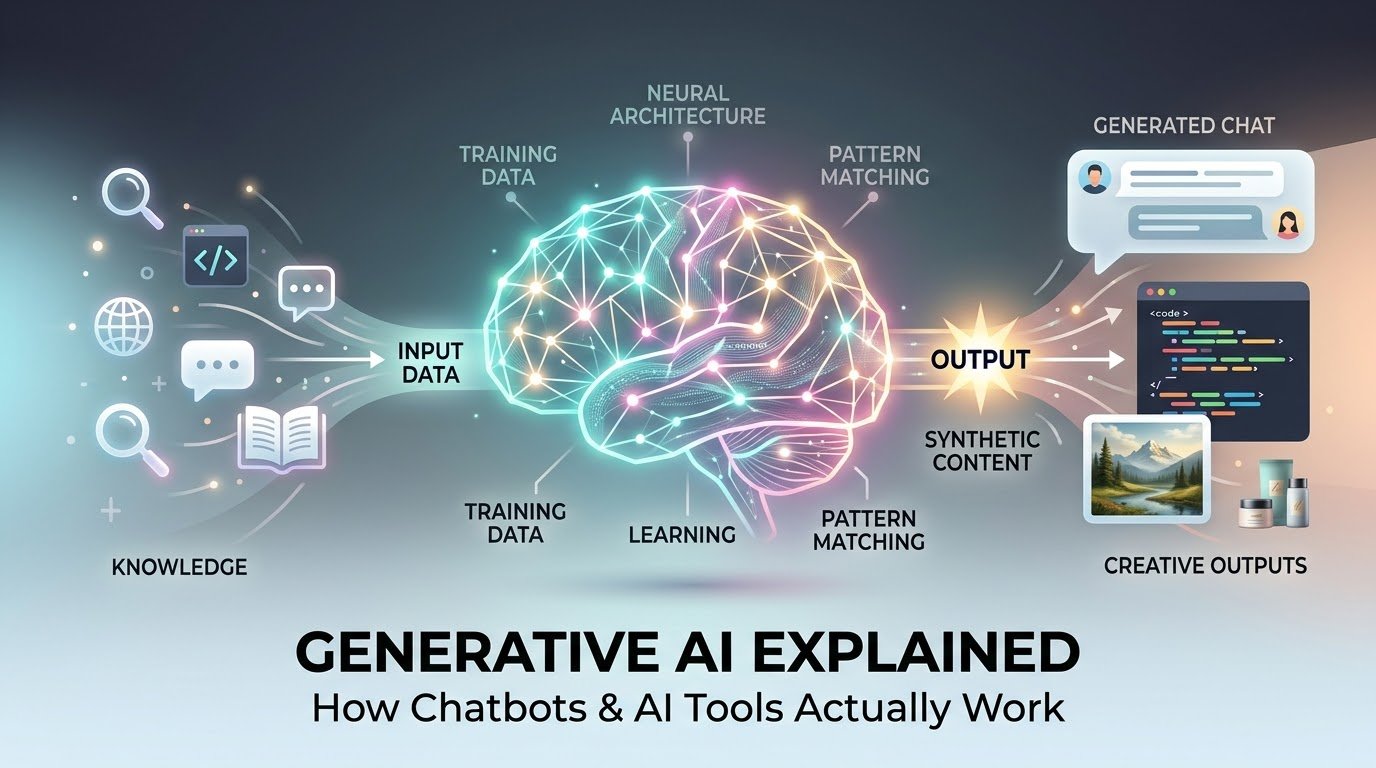
💬 What Is Generative AI?
One of the biggest developments in artificial intelligence is generative AI.
Unlike systems designed only to classify or predict information, generative AI can create new content.
Depending on the model, it can generate:
- 📝 Text
- 🖼️ Images
- 🎵 Music
- 🎥 Video
- 💻 Computer code
- 🎙️ Audio
- 📊 Summaries and reports
AI chatbots are a popular example.
A user can provide a natural-language instruction, and an AI model can generate an answer based on patterns learned during training and the information available to it.
Generative AI has made artificial intelligence accessible to people who do not have programming or technical backgrounds.
🌍 How AI Is Changing Everyday Life
Many people interact with AI without even realizing it.
AI can be found in everyday technologies such as smartphones, online services, navigation applications, social networks, streaming platforms, and search engines.
📱 AI in Smartphones
Modern smartphones increasingly use AI for tasks such as:
- Camera scene recognition
- Photo enhancement
- Voice assistants
- Translation
- Text prediction
- Call screening
- Battery optimization
- Image editing
- Security features
- Personalized recommendations
AI can analyze a photograph and automatically adjust exposure, focus, noise reduction, and other characteristics.
Some AI processing can also happen directly on the device, reducing the need to send every request to a remote server.
🔎 AI and Search
Search technology is also evolving.
Traditional search engines primarily returned lists of webpages matching a user’s query.
AI-powered search can go further by:
- Understanding the meaning of a question
- Identifying relevant information
- Combining information from multiple sources
- Generating a conversational response
- Helping users explore follow-up questions
This can make information discovery faster, but it also creates an important challenge: AI-generated answers must be accurate and properly verified.
AI systems can sometimes produce incorrect information that sounds convincing.
Therefore, users should not automatically assume that every AI-generated answer is correct.
🎓 AI in Education
Education is another area where artificial intelligence is having a major impact.
Students can use AI tools as learning assistants for:
- 📚 Explaining difficult concepts
- ✍️ Improving writing
- 🧮 Practicing mathematics
- 🌐 Translating languages
- 💡 Generating study ideas
- 📝 Creating practice questions
- 📖 Summarizing complex material
- 🗣️ Practicing communication skills
Teachers can also use AI for administrative and educational tasks.
For example, AI can help organize lesson materials, create quizzes, generate examples, and analyze certain types of student work.
However, education needs a careful balance.
Students should use AI as a learning tool, rather than allowing it to replace their own thinking.
The most valuable skills remain critical thinking, creativity, research ability, communication, and the ability to evaluate information.
🏢 AI in Business
Businesses are among the biggest adopters of AI technology.
Companies can use AI to automate repetitive tasks and analyze information more quickly.
Common business applications include:
- Customer support
- Marketing
- Data analysis
- Sales forecasting
- Document processing
- Software development
- Fraud detection
- Supply-chain management
- Recruitment assistance
- Business intelligence
⚙️ AI Automation
One of the most important trends is AI-powered automation.
Previously, automation often required clearly defined rules.
For example:
If a customer submits a form, send an email.
Modern AI systems can handle more complicated workflows involving language, documents, decisions, and multiple steps.
For example, an AI system might:
- Read a customer request.
- Understand the problem.
- Search a knowledge base.
- Draft a response.
- Classify the request.
- Send the request to the appropriate department.
This can save businesses significant amounts of time.
👨💻 AI and Software Development
Artificial intelligence is changing the way software is created.
Developers can use AI tools to:
- Generate code
- Explain unfamiliar code
- Find bugs
- Write tests
- Convert code between languages
- Create documentation
- Design software architectures
- Analyze errors
This does not mean programmers are becoming unnecessary.
Instead, the role of developers is changing.
A developer may spend less time writing repetitive code and more time:
- Designing systems
- Reviewing AI-generated code
- Solving complex problems
- Testing applications
- Making architectural decisions
- Ensuring security and reliability
The ability to understand software fundamentals remains extremely important.
🏥 AI in Healthcare
Healthcare is another field where AI has significant potential.
AI can assist with:
- Medical image analysis
- Research
- Drug discovery
- Patient monitoring
- Administrative work
- Medical documentation
- Risk prediction
- Personalized treatment research
For example, machine-learning systems can analyze large datasets and identify patterns that may be difficult for humans to detect manually.
However, healthcare is a high-stakes environment.
AI systems should not automatically replace qualified medical professionals. Decisions involving diagnosis or treatment require appropriate clinical oversight, validation, and consideration of individual circumstances.
The goal is generally to use AI as a tool that can assist professionals, rather than treating it as an infallible authority.
🔐 AI and Cybersecurity
Artificial intelligence is becoming increasingly important in cybersecurity.
Security systems can use AI to analyze enormous quantities of data and identify suspicious patterns.
Potential applications include:
- Detecting unusual login behavior
- Identifying malware
- Monitoring networks
- Detecting fraudulent transactions
- Finding suspicious emails
- Prioritizing security alerts
- Analyzing security logs
But AI is also being used by attackers.
Cybercriminals can use automation and generative technologies to make scams, phishing attempts, and malicious campaigns more convincing.
This creates an ongoing technological competition between attackers and defenders.
As AI becomes more capable, cybersecurity professionals will need increasingly sophisticated defensive systems.
🎨 AI in Creative Industries
AI is also transforming creative work.
People can use AI to assist with:
- Writing
- Graphic design
- Photography
- Video production
- Music creation
- Advertising
- Story development
- Animation
For example, a designer might use AI to quickly generate several visual concepts before refining one manually.
A writer might use AI to brainstorm ideas and then rewrite the material in their own voice.
The strongest creative workflows often combine human judgment with AI assistance.
AI can generate possibilities quickly, while humans provide taste, context, originality, emotional understanding, and final decision-making.
🚗 AI and Transportation
Transportation is another major application of artificial intelligence.
AI can help with:
- Traffic prediction
- Navigation
- Driver assistance
- Fleet management
- Route optimization
- Vehicle safety systems
- Autonomous-driving research
Navigation applications already use algorithms to estimate traffic conditions and recommend routes.
Advanced driver-assistance systems can use cameras, sensors, and AI algorithms to identify road conditions and potential hazards.
Fully autonomous transportation remains a complex engineering and regulatory challenge, particularly because real-world environments are unpredictable.
🌱 AI and Climate Technology
AI can also contribute to environmental efforts.
Potential applications include:
- Weather forecasting
- Energy optimization
- Smart electricity grids
- Agricultural monitoring
- Deforestation detection
- Climate modeling
- Water management
- Building energy optimization
For example, AI can analyze data from sensors and weather systems to help optimize energy consumption.
Farmers can also use data-driven systems to monitor crops and identify potential problems.
However, AI itself requires substantial computing resources, which means energy consumption and infrastructure efficiency are important considerations.
💼 Will AI Take People’s Jobs?
One of the biggest questions surrounding AI is employment.
The answer is more complicated than simply saying that AI will either “take all jobs” or “change nothing.”
AI is likely to automate some tasks, transform others, and create demand for new skills.
Jobs involving repetitive digital tasks may experience significant changes.
At the same time, new opportunities can emerge in areas such as:
- AI development
- Data analysis
- AI system management
- Cybersecurity
- Automation
- AI safety
- Product development
- Digital content
- AI-assisted professional services
The important distinction is between jobs and tasks.
A job may contain dozens of tasks. AI might automate several of them without eliminating the entire profession.
Workers who learn how to use AI effectively may be able to become more productive.
⚠️ The Biggest Problems With AI
Artificial intelligence has enormous potential, but it also has serious limitations.
1. Incorrect Information
Generative AI can sometimes produce false information.
A response may sound confident while still being incorrect.
This is sometimes called an AI hallucination.
For important decisions, information should therefore be checked against reliable sources.
2. Privacy
AI systems can process large quantities of information.
This creates questions about:
- Personal data
- User activity
- Sensitive documents
- Voice recordings
- Images
- Online behavior
Organizations need strong policies for collecting, storing, and using personal information.
Users should also avoid submitting sensitive information to AI services unless they understand how that information is handled.
3. Bias
AI systems learn patterns from data.
If training data contains biases, an AI system can potentially reproduce or amplify them.
Developers therefore need to evaluate AI systems carefully and test them across different situations and populations.
4. Deepfakes
AI-generated images, audio, and video can make it easier to create realistic fake content.
This can be used for harmless entertainment, but it can also contribute to:
- Fraud
- Impersonation
- Misinformation
- Reputation attacks
- Social engineering
As synthetic media becomes more convincing, digital literacy becomes increasingly important.
🛡️ How to Use AI Responsibly
Users can take several simple steps to use AI more effectively.
✅ Verify Important Information
Do not blindly trust AI-generated answers, especially when dealing with financial, legal, medical, or security decisions.
🔍 Check Original Sources
When information matters, go back to the original documentation, research, organization, or official source.
🔐 Protect Sensitive Information
Avoid sharing passwords, financial credentials, private documents, or other highly sensitive information with AI systems unless you understand the security and privacy implications.
🧠 Think Independently
AI should help you think—not replace your ability to think.
✏️ Review Generated Content
AI-generated text, code, images, and other material should be reviewed before publication or use.
🚀 What Will AI Look Like in the Future?
The next phase of artificial intelligence may involve systems that can perform increasingly complex multi-step tasks.
Instead of simply answering a question, an AI system may be able to:
- Understand a goal.
- Break the goal into smaller tasks.
- Use different software tools.
- Search for relevant information.
- Analyze the results.
- Complete actions.
- Review its work.
- Ask for human approval when necessary.
These systems are often described as AI agents or agentic AI.
The idea is to move from AI that simply responds to AI that can assist with workflows.
For example, a business might ask an AI system to prepare a market research report.
The system could potentially gather information, organize data, analyze trends, prepare a draft, and present the results for human review.
This could significantly change how people interact with computers.
🌐 AI Will Not Replace the Internet — It Will Change How We Use It
For decades, people primarily interacted with the internet through websites, applications, search boxes, and menus.
AI introduces another layer: natural-language interaction.
Instead of learning where a feature is located, a user can describe what they want.
For example:
“Analyze these sales numbers and explain why revenue declined.”
An AI system can potentially interpret the request and determine the necessary steps.
This could make technology easier for beginners while also making advanced tools more accessible.
🔮 The Future of AI Depends on Humans
Artificial intelligence is not simply a technology story. It is also a human story.
The most important question is not only:
“What can AI do?”
It is also:
“How should we use it?”
AI can increase productivity, accelerate scientific research, improve accessibility, automate repetitive tasks, and help people solve complex problems.
But it can also create risks involving privacy, misinformation, security, bias, employment, and misuse.
The future will depend on decisions made by developers, companies, governments, educators, and ordinary users.
📌 Key Takeaways
Artificial intelligence is becoming one of the most important technologies of the modern era.
Here are the key points to remember:
- 🤖 AI enables computers to perform tasks associated with human intelligence.
- 🧠 Machine learning allows systems to learn patterns from data.
- 💬 Generative AI can create text, images, code, audio, and other content.
- 📱 AI is increasingly integrated into smartphones and everyday applications.
- 🎓 Education can use AI as a personalized learning assistant.
- 🏢 Businesses can use AI for automation, analysis, and productivity.
- 💻 Developers can use AI to accelerate software development.
- 🔐 AI can strengthen cybersecurity but can also be abused by attackers.
- 🏥 AI has major potential in healthcare but requires careful human oversight.
- ⚠️ AI can produce inaccurate information and should not automatically be trusted.
- 🔒 Privacy and responsible data handling are increasingly important.
- 💼 AI is likely to change many jobs by automating tasks and creating new workflows.
- 🚀 AI agents could make future AI systems capable of completing complex multi-step tasks.
- 🧠 Human judgment, creativity, critical thinking, and responsibility will remain essential.
❓ Frequently Asked Questions About Artificial Intelligence
What is artificial intelligence in simple words?
Artificial intelligence is technology that allows computers to perform tasks that normally require human-like abilities, such as understanding language, recognizing patterns, analyzing information, and generating content.
Is AI the same as machine learning?
No. Machine learning is one approach used to create AI systems. Artificial intelligence is the broader field, while machine learning focuses on systems that learn patterns from data.
What is generative AI?
Generative AI refers to AI systems capable of producing new content, including text, images, audio, video, and computer code.
Can AI replace humans?
AI can automate many tasks, but whether it can replace an entire job depends on the nature of that job. Many professions involve human judgment, communication, creativity, physical work, or responsibility that cannot simply be automated.
Is AI always accurate?
No. AI systems can make mistakes and may sometimes generate convincing but incorrect information. Important information should always be independently verified.
Is AI safe to use?
AI can be used safely when users understand its limitations, protect sensitive information, verify important information, and use appropriate human oversight.
Why is AI becoming so popular?
Advances in computing power, data, machine-learning techniques, and AI model development have made modern AI systems much more capable and accessible.
🏁 Conclusion
Artificial intelligence in 2026 is no longer simply a technology of the future. It is already influencing how people work, communicate, study, create, shop, develop software, protect information, and interact with digital services.
The biggest transformation may not come from AI replacing humans completely. Instead, it may come from humans working with AI to accomplish tasks faster and explore possibilities that were previously difficult or expensive.
The people and organizations that understand both the capabilities and limitations of AI will be better positioned to benefit from it.
AI can generate an answer, analyze information, write code, create an image, or automate a workflow. But humans still need to provide goals, judgment, context, creativity, responsibility, and ethical decision-making.
The future of artificial intelligence will therefore not be determined by technology alone.
It will be determined by how intelligently we choose to use it.