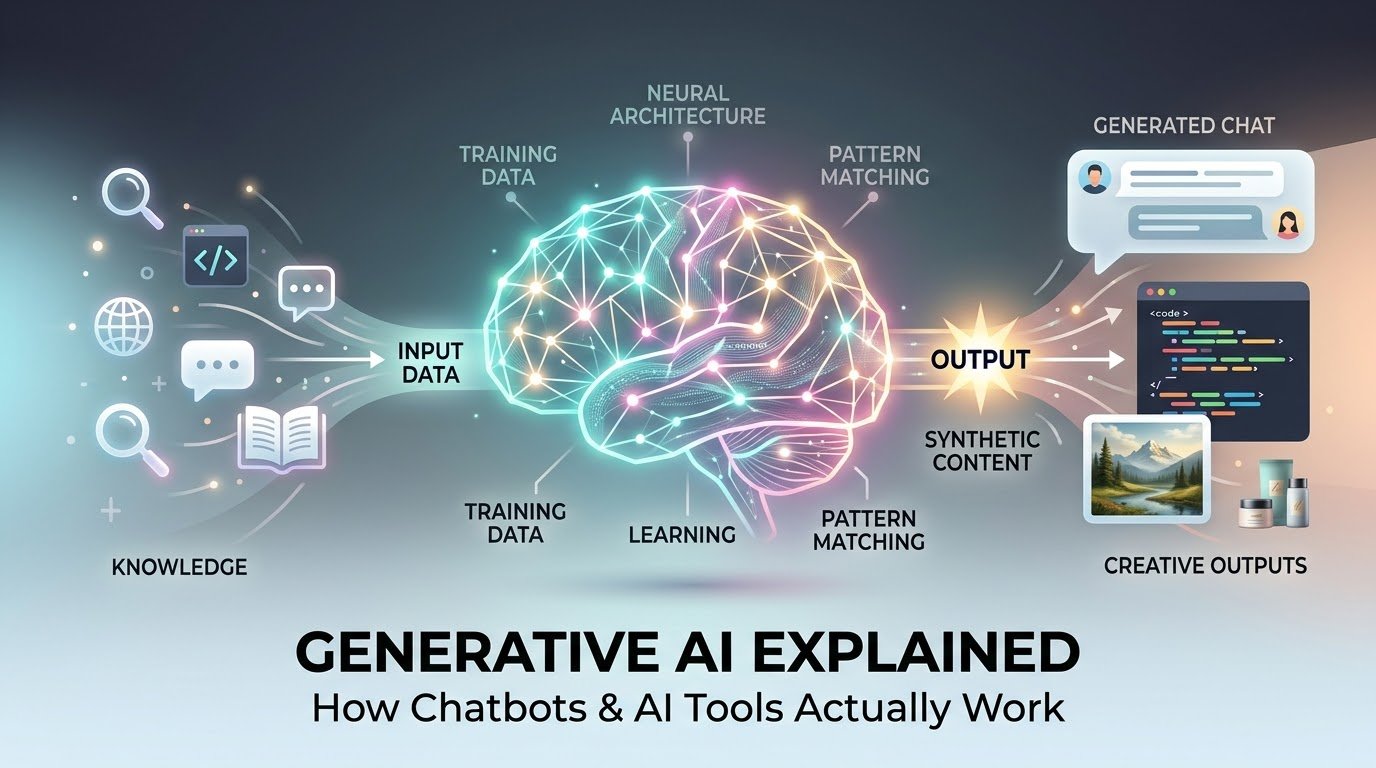
Generative Artificial Intelligence, commonly called Generative AI, has become one of the most talked-about technologies in the world.
AI chatbots can answer questions, write articles, summarize documents, generate code, create images, translate languages, analyze information, and help people complete many everyday tasks.
Tools powered by generative AI are now being used by students, developers, businesses, researchers, designers, content creators, marketers, and ordinary internet users.
But how does this technology actually work?
How can an AI system generate an answer that looks like it was written by a human?
How can AI create an image from a simple text description?
Why can AI sometimes produce completely incorrect information?
And what does the future of generative AI look like?
In this complete guide, we will explain generative AI in simple language, explore how AI chatbots work, discuss the technologies behind them, and examine their benefits, limitations, risks, and future possibilities.
🤖 What Is Generative AI?
Generative AI is a type of artificial intelligence designed to create new content.
Traditional computer programs generally follow specific instructions.
For example, a calculator receives numbers and mathematical instructions and produces a result.
Generative AI works differently.
It can learn patterns from large amounts of information and use those patterns to generate new outputs.
Depending on the system, generative AI can create:
- 📝 Text
- 🖼️ Images
- 🎵 Music
- 🎥 Video
- 💻 Computer code
- 🗣️ Speech
- 📊 Summaries
- 🌐 Translations
The generated content is not necessarily copied directly from a single source. Instead, the AI learns statistical and structural patterns from its training data and uses those patterns to produce an output.
💬 What Is an AI Chatbot?
An AI chatbot is software that allows people to communicate with an artificial intelligence system using natural language.
You can type a question or instruction, and the system generates a response.
For example, you might ask:
“Explain cloud computing to a beginner.”
The AI analyzes the request and generates an explanation based on patterns learned during training and, depending on the system, additional information or tools available at the time.
Modern AI assistants can do much more than simple question answering.
They can help with:
- Writing
- Coding
- Research
- Brainstorming
- Planning
- Translation
- Summarization
- Learning
- Data analysis
🧠 How Does Generative AI Learn?
Generative AI systems are trained using large collections of data.
For language models, training data can include large amounts of text from sources such as books, websites, articles, documentation, and other permitted datasets.
The exact data used varies from one AI system to another.
During training, the model learns patterns in the data.
It can learn relationships between:
- Words
- Sentences
- Concepts
- Programming instructions
- Languages
- Writing styles
- Topics
The model does not simply store every sentence like a traditional database.
Instead, training changes the model’s internal parameters so that it becomes better at recognizing and generating patterns.
🔢 What Are Tokens?
AI language models generally do not process text exactly the same way humans do.
Text is divided into smaller pieces called tokens.
A token may represent:
- A complete word
- Part of a word
- A punctuation mark
- A short sequence of characters
For example, a sentence can be converted into a sequence of tokens before being processed by the model.
The model works with these tokens mathematically.
This allows the system to process language using numerical representations.
📚 Training a Language Model
One important training approach is to give the model large amounts of text and ask it to predict missing or upcoming tokens.
For example:
“The sun rises in the ____.”
The model learns that words such as “east” are highly likely to follow the sentence.
The training process repeats this type of prediction across enormous amounts of data.
Over time, the model becomes much better at predicting what comes next.
But the result is more sophisticated than simple autocomplete because the model learns complex relationships between words, concepts, grammar, and context.
🧩 What Is a Large Language Model?
A Large Language Model, or LLM, is an AI model designed to process and generate human language at large scale.
Modern LLMs can contain very large numbers of parameters.
Parameters are numerical values inside the model that are adjusted during training.
They help determine how strongly different patterns are represented.
The exact architecture, number of parameters, training data, and training methods differ between AI models.
🏗️ The Transformer Architecture
One of the most important technologies behind modern language models is the Transformer architecture.
Transformers became highly influential because they can process relationships between different parts of a sequence efficiently.
A key concept within transformers is attention.
Attention allows the model to determine which parts of the input are particularly relevant when processing another part.
For example, consider:
“The computer was placed on the table because it was heavy.”
Understanding what “it” refers to requires considering the surrounding context.
Attention mechanisms help models analyze these relationships.
👀 What Is Attention?
Attention allows an AI model to assign different levels of importance to different parts of the input.
Suppose you provide a long paragraph and ask a question about it.
The model does not necessarily treat every word as equally important.
It can identify relationships between different pieces of information.
This helps the model maintain context and produce more coherent responses.
Attention is one of the fundamental ideas that made modern language models much more capable.
⚙️ What Happens When You Ask an AI a Question?
When you send a prompt to an AI chatbot, several steps can happen.
Step 1: Your Input Is Received
The system receives your message.
Step 2: The Text Is Tokenized
Your message is converted into tokens.
Step 3: The Model Processes the Context
The AI analyzes the tokens and relationships between them.
Step 4: The Model Predicts the Next Token
It calculates probabilities for possible next tokens.
Step 5: A Token Is Selected
The system chooses an appropriate token based on its generation process.
Step 6: The Process Repeats
The model generates additional tokens until it reaches an appropriate stopping point.
The final sequence of tokens is converted back into text that you can read.
This happens extremely quickly.
🎯 Is AI Simply Predicting Words?
Technically, language models generate text by predicting tokens.
But describing them as “just autocomplete” is an oversimplification.
Modern models can represent complex relationships and perform many tasks that appear to involve reasoning.
They can manipulate information, follow instructions, generate code, summarize documents, and solve many types of problems.
However, their capabilities and reliability vary depending on the task.
🧠 What Is a Prompt?
A prompt is the instruction or input given to an AI system.
For example:
“Write a 500-word article explaining cybersecurity to beginners.”
This is a prompt.
A prompt can contain:
- A question
- An instruction
- Background information
- Examples
- Constraints
- Formatting requirements
The quality and clarity of a prompt can strongly affect the usefulness of the result.
✍️ How to Write Better Prompts
A good prompt should clearly explain what you want.
Instead of:
“Write about AI.”
Try:
“Explain how generative AI works for beginners using simple language, headings, examples, and a short FAQ.”
The second prompt provides more context.
You can also specify:
- Target audience
- Desired length
- Tone
- Format
- Topic
- Important points
- Restrictions
🔄 Context Matters
Modern AI systems can use conversation context to understand follow-up instructions.
For example:
User: “Explain cloud computing.”
AI: Provides an explanation.
User: “Now explain it in simpler language.”
The second request depends on the previous conversation.
The AI can use the available context to interpret what “it” means.
However, context windows have limits, and systems may handle long conversations differently.
🧪 What Is Fine-Tuning?
Pretraining gives a model broad capabilities.
Fine-tuning can then adapt a model for particular tasks or behaviors.
A model might be fine-tuned to:
- Follow specific instructions
- Perform specialized tasks
- Produce particular formats
- Work better in certain domains
- Follow safety requirements
Fine-tuning is one part of the broader process used to make AI systems useful for real-world applications.
👨🏫 Human Feedback and AI Training
Human feedback can also be used to improve AI systems.
People may evaluate model responses based on factors such as:
- Helpfulness
- Accuracy
- Relevance
- Safety
- Clarity
This feedback can be used during additional training processes.
The goal is to make the model’s behavior more useful and aligned with desired instructions.
🖼️ How Does AI Generate Images?
Generative AI is not limited to text.
Image-generation systems can create images from prompts such as:
“A futuristic city at night with flying vehicles and glowing buildings.”
The system processes the text description and generates an image representing the requested concepts.
Many modern image-generation systems use diffusion-based methods or related generative techniques.
🌫️ What Is Diffusion?
Diffusion models are trained to generate data by learning how to reverse a process that gradually adds noise.
During generation, the system begins from a noisy representation and repeatedly transforms it toward a meaningful image.
At each stage, the model attempts to move closer to the desired result.
The final output can be a detailed image corresponding to the user’s prompt.
🎨 AI Image Generation
AI image systems can generate:
- Illustrations
- Photorealistic scenes
- Concept art
- Logos and design concepts
- Backgrounds
- Product concepts
- Character designs
- Educational visuals
They can also sometimes edit existing images.
For example, a user may ask an AI system to change the background, remove an object, or modify the artistic style of an image.
🎵 Generative AI for Music
Generative AI can also work with audio.
AI systems can generate or transform:
- Music
- Sound effects
- Voice
- Speech
- Audio backgrounds
Text-to-speech technology can generate spoken audio from written text.
This has applications in:
- Accessibility
- Education
- Entertainment
- Games
- Customer service
- Video production
💻 AI and Programming
Generative AI has become especially useful for software development.
AI coding tools can help developers:
- Write code
- Explain code
- Find bugs
- Generate tests
- Refactor programs
- Convert code between languages
- Create documentation
For example, a developer could describe a function in natural language and ask an AI assistant to create an initial implementation.
However, generated code should be tested carefully.
AI can produce code that looks correct but contains subtle bugs or security vulnerabilities.
🔍 AI and Search
Generative AI is also changing how people search for information.
Traditional search engines typically return a list of webpages.
Generative systems can provide a direct conversational response.
This can be useful when someone wants:
- A summary
- An explanation
- A comparison
- A step-by-step guide
However, AI-generated answers should not automatically be treated as authoritative.
For important topics, users should verify information using reliable sources.
📚 Generative AI in Education
Students can use AI tools for learning in many ways.
AI can help:
- Explain difficult concepts
- Create practice questions
- Summarize material
- Provide examples
- Help with brainstorming
- Explain programming
- Translate educational content
For example, a student might ask:
“Explain photosynthesis as if I am a beginner.”
The AI can provide a simplified explanation.
The most effective use of AI in education is often as a learning assistant rather than a replacement for learning.
🏢 Generative AI in Business
Businesses are using generative AI for many tasks.
Common applications include:
- Customer support
- Marketing
- Content creation
- Data analysis
- Document summarization
- Internal knowledge systems
- Software development
- Research
AI can help employees complete repetitive tasks more quickly.
However, businesses need appropriate policies for privacy, security, accuracy, and human oversight.
💬 AI Customer Support
AI-powered chatbots can answer common customer questions at any time.
They can potentially help customers with:
- Product information
- Account questions
- Troubleshooting
- Order information
- Frequently asked questions
Human agents can then focus on more complicated issues.
A good customer-support system should provide an easy way to reach a human when necessary.
🏥 Generative AI in Healthcare
AI may assist healthcare professionals with tasks such as:
- Document summarization
- Administrative work
- Research
- Information retrieval
- Communication
However, healthcare is a high-stakes field.
AI systems can make mistakes, so medical decisions should involve qualified professionals and appropriate clinical processes.
⚖️ Why Can AI Make Mistakes?
One of the most important limitations of generative AI is that it can produce incorrect information.
Sometimes the response can sound extremely confident even when it is wrong.
This behavior is often called an AI hallucination.
An AI system may:
- Invent a source
- Misstate a fact
- Confuse two people
- Generate incorrect statistics
- Produce outdated information
- Create a nonexistent reference
This is why users should verify important information.
🧠 AI Does Not Understand Everything Like a Human
AI can demonstrate impressive language abilities, but it does not mean that it understands the world exactly like a human being.
Its behavior comes from learned representations, algorithms, training, context, and other system components.
It can make mistakes when:
- The prompt is ambiguous
- Information is missing
- The topic is highly specialized
- The task requires current information
- The problem requires precise reasoning
- The system misunderstands context
Users should therefore treat AI as a powerful tool rather than an infallible authority.
🔐 Privacy and Generative AI
Privacy is an important consideration when using AI tools.
Users should be careful about entering sensitive information.
Depending on the service and its settings, information submitted to an AI system may be processed or stored according to the provider’s policies.
Avoid unnecessarily sharing:
- Passwords
- Authentication codes
- Financial credentials
- Private documents
- Sensitive personal information
Organizations should also establish clear rules about what employees are allowed to enter into AI systems.
🛡️ AI and Cybersecurity
Generative AI has both defensive and offensive implications for cybersecurity.
Security teams can use AI to help:
- Analyze logs
- Identify suspicious activity
- Summarize security events
- Generate detection rules
- Investigate incidents
At the same time, attackers can use AI to improve phishing messages, automate scams, or generate malicious content.
This means cybersecurity teams need to continuously adapt.
⚠️ Deepfakes and Synthetic Media
Generative AI can create convincing synthetic images, audio, and video.
This creates serious challenges.
Someone could potentially create fake media that appears to show a person saying or doing something they never actually said or did.
Synthetic media can be used for:
- Entertainment
- Education
- Film production
But it can also be abused for:
- Fraud
- Harassment
- Misinformation
- Impersonation
- Scams
As generative technology improves, verifying digital content will become increasingly important.
📰 AI and Misinformation
Generative AI can produce large amounts of text quickly.
This creates the possibility of automated misinformation campaigns.
People should be cautious when encountering suspicious online content.
Useful habits include:
- Checking the original source
- Comparing multiple reliable sources
- Looking for evidence
- Checking publication dates
- Avoiding emotionally manipulative content
- Verifying images and videos when necessary
⚖️ Copyright and Generative AI
Copyright is another major issue surrounding generative AI.
Questions include:
- What training data can AI systems use?
- Who owns generated content?
- Can copyrighted material be reproduced?
- How should creators be compensated?
- What happens when AI output resembles existing work?
Laws and legal interpretations continue to develop in different countries.
Anyone using AI commercially should understand the applicable rules and the terms of the AI service they use.
👨💼 Will AI Replace Jobs?
This is one of the biggest questions surrounding generative AI.
AI will likely automate some tasks.
Jobs that involve highly repetitive digital work may experience significant changes.
But automation does not necessarily mean entire occupations disappear.
In many cases, AI may change how people perform their jobs.
For example:
- Developers may use AI coding assistants.
- Designers may use AI image tools.
- Writers may use AI for brainstorming.
- Analysts may use AI for data exploration.
- Customer-service employees may work alongside AI assistants.
The future may involve humans and AI working together.
🧑🤝🧑 Human + AI Collaboration
One of the most important concepts in the future of work may be collaboration.
Humans are good at:
- Judgment
- Creativity
- Communication
- Emotional understanding
- Decision-making
- Real-world context
AI is good at:
- Processing large amounts of information
- Generating drafts
- Recognizing patterns
- Automating repetitive tasks
- Producing multiple possibilities quickly
Combining these strengths can be more powerful than relying exclusively on either one.
⚡ Benefits of Generative AI
Generative AI provides many potential benefits.
🚀 Productivity
AI can help people complete certain tasks faster.
📚 Learning
It can explain difficult concepts in different ways.
💻 Programming
AI can assist developers with coding and debugging.
🎨 Creativity
It can help generate ideas, images, text, and other creative material.
🌍 Translation
AI can help people communicate across languages.
♿ Accessibility
Speech generation, transcription, translation, and other AI tools can improve accessibility.
💼 Business Efficiency
Organizations can automate repetitive processes and support employees.
⚠️ Limitations of Generative AI
Generative AI also has important limitations.
❌ Incorrect Information
AI can produce false answers.
🔐 Privacy Risks
Sensitive information may be exposed if users handle AI tools carelessly.
⚖️ Legal Questions
Copyright and ownership rules can be complicated.
🧠 Overdependence
People may become too dependent on automated systems.
🎭 Manipulation
Synthetic content can be used to deceive people.
💰 Infrastructure Costs
Advanced AI systems require significant computing resources.
🌱 The Environmental Impact of AI
Large AI systems require substantial computing infrastructure.
Data centers consume:
- Electricity
- Cooling resources
- Hardware
- Networking capacity
As AI usage increases, improving energy efficiency becomes increasingly important.
Future AI systems may focus on doing more work with fewer computing resources.
Efficient hardware, optimized models, and better data-center infrastructure can help reduce environmental impact.
🔮 The Future of Generative AI
Generative AI is still developing rapidly.
Future systems may become better at:
- Reasoning
- Planning
- Multimodal understanding
- Coding
- Research
- Personal assistance
- Real-time interaction
AI systems may increasingly work across multiple types of information at once.
For example, a future assistant might understand:
- Text
- Images
- Audio
- Video
- Screen content
- Documents
- Structured data
This is called multimodal AI.
👁️ What Is Multimodal AI?
Multimodal AI can process multiple forms of information.
Instead of only reading text, an AI system might analyze an image and answer questions about it.
It could potentially combine:
- Text
- Images
- Audio
- Video
For example, you could upload a photograph and ask:
“Explain what is happening in this image.”
The system could analyze visual information and respond in natural language.
🤖 AI Agents
Another major development is AI agents.
A traditional chatbot mainly responds to requests.
An AI agent can potentially perform multiple steps to achieve a goal.
For example, instead of simply answering:
“How can I organize my tasks?”
an agent could potentially help create a plan, organize information, use connected tools, and complete approved actions.
This moves AI from simple conversation toward task execution.
🔄 AI Will Become More Integrated
Generative AI may become less visible as a separate application.
Instead, it could become a standard feature inside:
- Smartphones
- Browsers
- Operating systems
- Office software
- Design applications
- Development environments
- Search systems
- Cars
- Smart homes
Users may simply interact with software naturally without thinking about whether a particular feature is powered by AI.
🧠 The Importance of AI Literacy
As AI becomes more common, people will need basic AI literacy.
Users should understand:
- What AI can do
- What AI cannot do
- How to write useful prompts
- How to verify information
- How to protect privacy
- How to identify synthetic content
- When human expertise is necessary
AI literacy may become as important as basic digital literacy.
📊 A Simple Generative AI Workflow
The basic process can be summarized like this:
User Prompt → Tokenization → AI Model → Probability Calculations → Generated Output
For image generation, the process can be different:
Text Prompt → AI Interpretation → Generative Process → Image Output
For more advanced AI systems, additional steps may involve:
Prompt → Model → Tools/Data → Reasoning or Processing → Final Response
The exact architecture depends on the AI system.
🧪 Why AI Sometimes Produces Different Answers
If you ask the same question multiple times, an AI system may not always provide exactly the same response.
This can happen because generation involves probabilities and sampling strategies.
The system may have multiple reasonable ways to continue a response.
This variability can be useful for creative tasks, but it can also make consistency more difficult.
🛠️ How to Use Generative AI Effectively
To get better results:
1. Be Specific
Clearly explain what you want.
2. Provide Context
Give the AI relevant background information.
3. Specify the Format
Ask for a table, list, article, summary, or another structure.
4. Define the Audience
Tell the AI whether the content is for beginners, professionals, students, or another audience.
5. Review the Output
Do not automatically publish or use everything AI generates.
6. Verify Important Facts
Especially for financial, legal, medical, technical, and current information.
❓ Frequently Asked Questions
1. What is generative AI?
Generative AI is artificial intelligence that can create new content such as text, images, audio, video, and code.
2. How do AI chatbots work?
AI chatbots process user input, analyze the context, and generate responses using models trained on large amounts of data.
3. What is an LLM?
An LLM, or Large Language Model, is an AI model designed to process and generate human language.
4. What is a token?
A token is a unit of text processed by an AI language model. It can represent a word, part of a word, punctuation, or another small sequence.
5. What is a transformer?
A transformer is a neural-network architecture that uses mechanisms such as attention to process relationships within sequences. It is a major foundation of many modern language models.
6. Can AI understand everything?
No. AI systems have limitations and can misunderstand prompts, lack current information, or produce incorrect answers.
7. What are AI hallucinations?
AI hallucinations are cases where an AI system generates information that appears plausible but is incorrect, fabricated, or unsupported.
8. Can generative AI create images?
Yes. Specialized generative AI systems can create images from text descriptions and can also support various image-editing tasks.
9. Can AI replace programmers?
AI can automate some programming tasks, but human developers remain important for architecture, testing, security, requirements, debugging, and decision-making.
10. Is generative AI safe?
Generative AI can be used safely in many situations, but users should consider privacy, security, misinformation, copyright, and accuracy risks.
11. Will generative AI replace humans?
Generative AI is more likely to automate and transform many tasks than simply replace all human workers. Human judgment and expertise will remain important.
12. What is multimodal AI?
Multimodal AI can process multiple types of information, such as text, images, audio, and video.
🚀 Conclusion
Generative AI is changing the way people interact with computers.
Instead of communicating with software only through buttons, menus, and complicated commands, people can increasingly describe what they want using natural language.
AI systems can generate text, images, code, audio, and other forms of content. They can help people learn, work, create, research, and solve problems.
Behind these impressive capabilities are technologies such as large language models, transformers, attention mechanisms, machine learning, neural networks, and generative techniques.
However, generative AI is not perfect.
It can make mistakes, produce misleading information, create synthetic media, raise privacy concerns, and introduce complicated legal and ethical questions.
The best approach is therefore neither to blindly trust AI nor to ignore it.
Instead, people should learn how these systems work, understand their limitations, verify important information, protect sensitive data, and use AI as a powerful tool alongside human judgment.
The future of generative AI will likely involve much more than chatbots.
AI may become integrated into smartphones, computers, websites, applications, vehicles, smart homes, and professional tools. AI agents may also become capable of performing increasingly complex tasks.
One thing is already clear:
Generative AI is changing computing from a tool that people operate into a technology that people can communicate with.
And as these systems continue to improve, understanding how they work will become an increasingly valuable skill in the digital world.